How Much Does Printing on Cotton Cost? A Guide for Brands
The cost of printing on cotton doesn’t come down to a single rate per metre. This is usually the first question in a conversation with a print house. For a brand, what matters more is how much the fabric ultimately costs in the finished product.
That is why it helps to think more broadly about the question, “How much does printing on cotton cost?”. Only when you know the details below can you assess whether a given production scale makes business sense.
Key takeaways:
- the cost of printing on cotton depends on the material, technology, file preparation, testing, finishing, and logistics;
- the price per metre alone is not enough to assess profitability – a brand should calculate the cost per finished item;
- pigment and reactive printing differ in both process and cost structure, so the technology should be matched to the specific base fabric, product, and expected result;
- finishing after printing can have a real impact on hand feel, stability, shrinkage, sewing, and how the material is perceived by the end customer.
What affects the cost of printing on cotton?
The cost of printing on cotton results from several elements that work together. The most important are: the base material, printing technology, file preparation, production scale, colour coverage, finishing, process losses, and transport.
Cotton is not just one material. For example a lightweight woven cotton fabric for accessories is calculated differently from jersey for children’s clothing. Differently again from sweatshirt knit for hoodies. If you are still choosing the base for your collection, a good first step is to compare fabrics.
[See cotton woven and knit fabrics for printing]
Base material: woven fabric, knit fabric, weight, and composition
The first cost decision concerns the material itself. Price is affected by the type of cotton, weight, weave, stretch, usable width, and certifications. A lighter fabric may have a lower entry cost, but will not always be the best option for the product. A heavier knit will be more expensive to buy and transport, but it may be better suited to a hoodie, blazer, or trousers.
In the calculation, it is worth comparing not only the linear metre, but also the efficiency of the material. In practice, a wider or more stable base may generate less cutting waste. This means a lower cost per finished item.
| Material element | How does it affect the calculation? | What should the brand check? |
|---|---|---|
| Weight | the heavier the material, the higher the raw material and transport cost | whether the weight fits the final product |
| Usable width | determines how many pattern pieces fit on the roll | cost should be based not on the metre, but on actual consumption |
| Weave type | affects hand feel, drape, and how the print is perceived | whether the material behaves well after sewing |
| Stretch | important for jersey, leggings, bodysuits, and children’s clothing | whether the design distorts when stretched |
| Certifications | may increase the cost of the base, but also the value of the product | whether they are needed for the target group |
Pigment or reactive printing — which is more cost-effective for a brand?
When it comes to printing on cotton, the most common comparison is between pigment printing and reactive printing. However, it is not worth placing them in a simple either/or framework: final quality always depends on the full path the material has to go through.
Technology alone does not determine either the result or the profitability. The cost of printing on cotton fabrics should be evaluated in the context of the specific base fabric: the specific design, the production scale, and the expected finishing.
With other fibres, the calculations look different: sublimation is used mainly for polyester, while acid printing is used for materials that require a different type of dye and process. That is why the technology should be matched to the specific composition and construction of the woven or knitted fabric.
Pigment printing on cotton
This type of printing applies pigment to the surface of the material and fixes it through heat. It is a flexible technology: it works well for prototypes and short runs, but it can also be a good solution for regular production, provided there is good control over the base material, colour profiles, fixation, and batch-to-batch quality.
Pigment printing can make it easier to control repeatability between runs, because the process is shorter and does not require as many wet-processing stages as reactive printing.
Reactive printing on cotton
Reactive printing is based on bonding the dye to the fibre. It often delivers very good saturation, a soft hand feel, and high durability, but it requires a more complex process: material preparation, fixation, washing, and stabilisation.
The cost of reactive printing can sometimes be slightly higher. This results not only from the technology itself, but above all from the longer and more complex production path. Every stage — from material preparation, printing, and drying, through steam fixation and washing, to final drying and stabilisation — affects time, resource use, quality control, and the final product cost.
This solution makes sense when your product requirements justify a more advanced process.
Comparison of cotton printing technologies
| Criterion | Pigment printing on cotton | Reactive printing on cotton |
|---|---|---|
| Process | shorter, usually without washing after printing | more complex, with fixation and washing |
| Production scale | flexible: from tests to medium and regular runs | suitable when the scale and budget justify a more complex process |
| Repeatability between runs | potentially easier to control thanks to the shorter process, with good colour and material management | good, but requires stable control of preparation, fixation, washing, and finishing |
| Hand feel | depends on the pigment, preparation, fixation, and finishing | often very soft, because the dye bonds with the fibre |
| Process cost | usually less complex thanks to fewer processing stages | usually higher because of the more complex process |
| What tends to increase the price most | base material quality, material preparation, fixation, finishing | material preparation, fixation, washing, stabilisation |
| When it makes sense | when a brand needs flexibility, repeatability, cost control, and scaling potential | when specific product requirements justify a reactive process |
See our full comparison: reactive vs pigment printing on cotton.
If you want to explore the technology side further, check our guide on how to choose the right cotton printing technology.
Why is the price per metre not enough?
Unfortunately, the price per linear metre can be misleading, because it never tells you exactly how many products will actually be made from the material. For businesses, the cost of one finished item matters more than the nominal price per metre.
For example: two materials may have a similar price per metre, but differ in width, stability, and cutting waste. A wider or more predictable fabric may give a lower cost per hoodie, even if its metre price seems higher.
Your calculation should include:
- roll width and printable width;
- pattern layout;
- directional design;
- shrinkage after processing;
- technical allowance;
- cutting waste;
- the number of designs in the order;
- transport of the material to the sewing workshop.
Fabric finishing after printing and the real cost of production
Finishing is one of the most important parts of the calculation. It affects not only cost, but also how the finished product is perceived. The quality of printing on cotton does not depend solely on the print itself. What happens to the material before printing – pre-treatment and after printing – post-treatment – also matters.
Pre-treatment means preparing the material before printing. This is the stage that affects colour uptake, process stability, and predictability of the result. Post-treatment includes what happens after printing: fixation, stabilisation, softening, quality control, and any additional finishing processes.
Finishing is not a set of isolated treatments. It’s a whole group of production decisions. The process may include stages such as: preparing the cotton for printing, fixation, softening, stabilisation, shrinkage control, and quality control. Each of these affects the hand feel of the material, its resistance in use, and the repeatability of the final effect.
Finishing also determines how the material behaves during sewing. Whether it shifts too much after washing, whether it feels too stiff or too “dry,” and how it affects wearing comfort. From a brand’s perspective, the end customer does not evaluate the printing technology itself, but the final result of the whole process: base fabric + print + fixation + finishing.
That is why this process is not a technical detail. It’s real part of calculating production risk, quality, and profitability.
Why does finishing matter for a brand?
A well-finished material can reduce the risk of claims, improve wearing comfort, and make sewing easier. Ignoring this stage, or treating it as a minor detail, can lead to problems: a stiff hand feel, greater shrinkage, differences between runs, more difficult work in the sewing workshop, or poorer product perception by the customer.
This is especially important when a brand compares the price of printing on cotton across different suppliers. A lower price per metre may not mean a lower production cost. If the material requires extra work after printing, is harder to sew, or generates a higher risk of claims.
How do you calculate the real cost of printing on cotton?
The best approach is to calculate the cost step by step, without focusing only on the price per metre.
1. Calculate the cost of production material
Production metreage × cost of printed material = base material cost
This is the starting point, but not the full calculation. At this stage, you only know how much the printed roll costs.
2. Add file preparation and testing
You should add the cost of a sample or test swatch to the budget, and in some cases also a wash test or a use test.
3. Add finishing
Softening, stabilisation, or other finishing should be treated as a separate line item, because they affect hand feel, shrinkage, product perception, and the risk of claims.
4. Add a technical allowance
Do not calculate production down to the exact centimetre. Your estimate should include an allowance for machine start-up, the end of the roll, cutting, testing, and any potential losses after processing.
5. Add logistics
Transport to the sewing workshop, packing on a roll, extra sample shipments, and waiting time for the material are also part of production cost. For larger orders, logistics can become a significant budget item.
6. Convert the cost into the finished product
The most important stage in determining the price of printing on cotton is converting the material cost into a finished item:
actual cost of production material / number of finished products = cost of printed material per item
Example: a clothing brand plans to sew a run of children’s sweatshirts from cotton knit fabric. The price per metre is not enough for the calculation. You need to work out how many sweatshirts will actually come from the roll. Once you account for fabric width, pattern layout, technical allowance, samples, shrinkage, finishing, and transport to the sewing workshop.
If the ordered material produces a specific number of finished sweatshirts, the total cost of the printed material should be divided by that number of pieces. Only then can you see how much printed cotton really costs in one product.
Sometimes a more expensive, but more stable or wider material gives a lower cost per finished piece than a cheaper base with more waste.
How can you reduce cost without reducing quality?
The biggest savings usually come from planning, not from choosing the cheapest cotton. A brand can lower production cost if it prepares files better, limits the number of random base fabrics, and includes testing before ordering a larger metreage.
Design the pattern around the fabric width
The pattern repeat should fit the usable width of the roll. If the design creates large margins or requires a difficult layout, the brand pays for material it will not use.
Consolidate materials and designs
Instead of printing many designs on many different base fabrics, it is worth planning the collection around one or two cotton bases. This makes testing, sewing, quality control, and logistics easier.
Test before placing a larger order
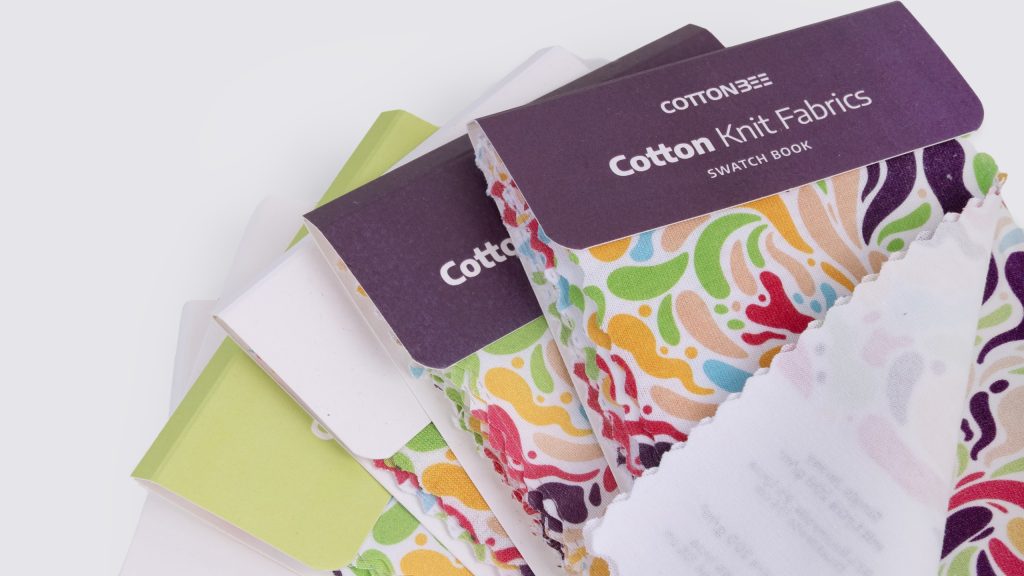
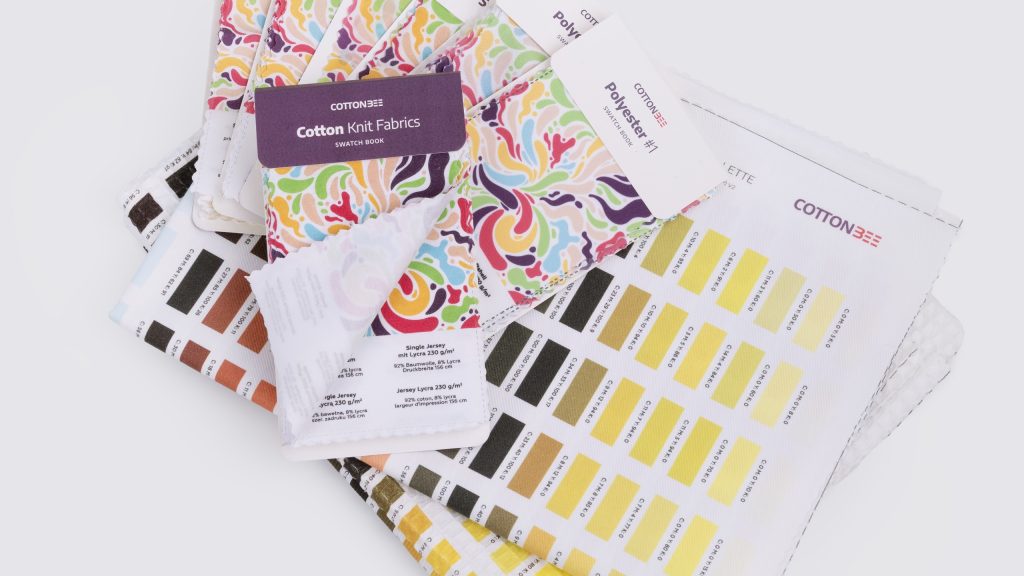
A sample or test swatch allows you to check colour, pattern scale, hand feel, weight, and material behaviour. When choosing a base fabric, it is worth using a fabric sample book, especially if the decision depends on hand feel, thickness, and colour.
Plan the production scenario
A prototype is calculated differently from a short run, and a short run is calculated differently again from a regular restock.
- Prototype: the goal is testing, not the lowest unit cost.
- Short run: the priority is reducing risk and making good use of the metreage.
- Regular production: repeatability, material stability, logistics, and predictability between runs become the key factors.
What should you prepare before asking for a quote?
Before talking to a print house, prepare:
- the type of final product, e.g. hoodie, T-shirt, bodysuit, bedding, bag;
- the preferred cotton type: woven fabric, jersey, sweatshirt knit, organic cotton;
- approximate metreage;
- number of designs;
- information on whether the design is a repeat, a panel, or a directional print;
- the expected hand feel;
- durability and washing requirements;
- whether you need a sample or test swatch;
- the delivery location: brand, cutting room, or sewing workshop;
- information on whether the production is a prototype, short run, or restock.
The more specific the brief, the easier it is to prepare a reliable estimate. Not only of the price per metre, but of the real material cost within a production scenario. This helps the print house choose the right base fabric, technology, level of testing, and finishing for the final product.
[Request a production cost estimate]
Summary: how much does printing on cotton cost?
The cost of printing on cotton depends on the whole process. The base material, technology, file preparation, testing, finishing, losses, logistics, and final use. That is why production should not be judged only by the price per metre.
For your brand, the most important question should be: how much does the printed fabric cost in one finished item? Only that calculation shows whether the product has a healthy margin, whether the material performs well in sewing, and whether the technology fits the purpose of the collection.
Pigment and reactive printing have different advantages. But no technology is automatically the best. The best choice is the one that fits your product.
FAQ – the cost of printing on cotton
It depends on the type of cotton, the printing technology, metreage, number of designs, file preparation, colour coverage, finishing, process losses, and logistics.
Usually yes, because it requires a more complex process. Material preparation, steam fixation, washing, and final finishing. That does not mean it will always be the better choice. The decision should depend on the product, the expected hand feel, durability, production scale, and budget.
No. The price per metre shows only part of the cost. A brand should convert the cost of printed material into the finished product, taking into account roll width, waste, finishing, testing, and transport.
Yes. A sample or test swatch allows you to check colour, hand feel, pattern scale, shrinkage, and material behaviour before placing a larger order.