What Fabrics Should You Choose for a Printed Autumn Collection?
If you are planning an autumn drop or developing your brand’s next collection, do not look for one universal fabric for the entire season. The right autumn fabrics should match the product, cut and intended use: loopback jersey works well for sweatshirts and sets, cotton twill or gabardine for more structured garments, and softshell for functional clothing.
Autumn fabrics: Key takeaways
- Choose the fabric for the garment and its intended use, not just for the season.
- Loopback jersey is a versatile choice for sweatshirts, joggers, sweatshirt dresses and children’s clothing.
- The right single jersey and rib knit work well for long-sleeve tops, roll-necks, fitted tops, dresses and selected children’s garments.
- Cotton twill and gabardine hold their shape better, making them suitable for trousers, skirts, overshirts and accessories.
- Softshell is a practical choice for functional and outdoor collections.
Where should you start when choosing fabric for an autumn collection?
An autumn fabric does not simply mean a thick fabric. An autumn collection may include warm sweatshirts, trousers, dresses, transitional jackets and functional accessories. Each product needs different properties.
Before choosing your fabric, answer five questions:
1. What exactly are you planning to produce?
A fitted roll-neck needs a different fabric from an oversized sweatshirt or a transitional jacket.
2. Does the garment need to stretch?
Stretch is important for pull-on garments, fitted styles and children’s clothing.
3. Should the fabric hold its shape?
Trousers, blazers, overshirts and bags need more structure than soft long-sleeve tops.
4. How warm should the finished garment be?
Warmth depends on more than fabric weight. Construction, weave or knit structure, finish and the way the garment is worn also matter.
5. How should the print look on the finished garment?
A smooth surface shows fine details more clearly. A visible weave, knit structure or soft brushed finish can give the design a more tactile, subdued look.
For more basic selection criteria, see our guide: How to choose a dressmaking fabric?
Which woven and knitted fabrics work best for autumn?
In everyday language, we often use the word “fabric” for all sewing materials. Technically, however, it is useful to distinguish woven fabrics from knitted fabrics.
Knitted fabrics such as jersey and sweatshirt knits are made from interconnected loops. They are soft and stretchable. Woven fabrics such as cotton twill and gabardine are made from interlaced warp and weft threads. They are usually more stable and hold a defined shape better.
| Fabric | Key properties | How does it affect the print? | What should you check on a sample? |
|---|---|---|---|
| Loopback jersey | Soft and comfortable; stretch, weight and composition depend on the variant | The print may look softer than on a smooth knit | Fine-line clarity, black depth, how the design behaves when stretched |
| Brushed sweatshirt jersey | Thicker, warmer, with a soft brushed inside | Texture may soften fine details; larger motifs usually remain clearer | Effect of texture on detail, actual colour, behaviour after washing |
| Single jersey | Soft, lightweight and usually moderately stretchy; properties depend on composition | A smooth surface can show outlines and smaller details clearly | Text and line clarity, twisting, actual print colour |
| Jersey with Lycra | More elastic and better at returning to shape than standard single jersey | The print stretches with the fabric and may change proportions | Motif distortion, base showing through, black depth |
| Rib knit | Stretchy, resilient and visibly textured | The ribs become part of the visual effect | Print clarity relaxed and stretched, effect of ribs on detail |
| Cotton twill | Durable, stable, with a visible diagonal weave | The weave gives the print a distinct texture | Effect of weave on fine lines, colour saturation and small details |
| Gabardine | Dense and stable; stiffness depends on composition and weight | The dense weave can help retain detail but remains visible | Drape, black depth, appearance of the print around folds |
| Softshell | Protects against wind, moisture and cold depending on its technical parameters | Print results depend on surface, composition and printing technology | Colour intensity, texture, surface durability and behaviour when folded |
| Woven viscose | Usually soft and fluid, although drape and stability depend on weave and weight | Can create a light, elegant print effect | Dimensional stability, shrinkage, detail sharpness and actual colour |
| Viscose knit | Soft and stretchy; elasticity depends on construction and fibre blends | The design may stretch with the fabric and change proportions | Recovery, motif distortion, show-through and behaviour after washing |
Loopback jersey: a versatile base for an autumn collection
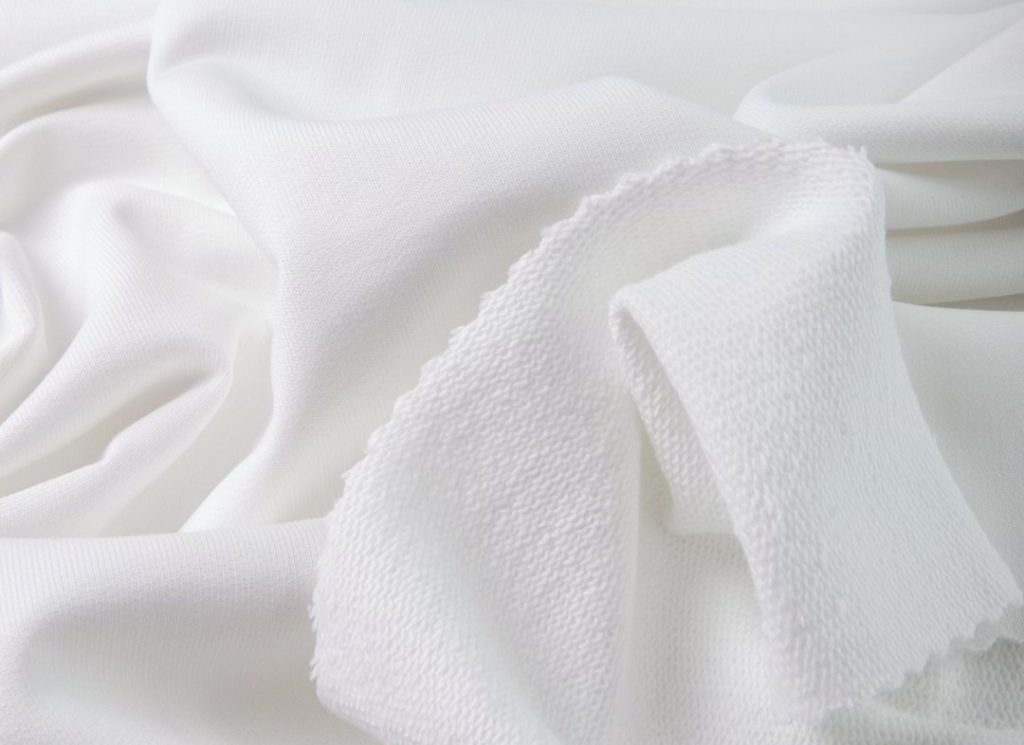
Loopback jersey is one of the most practical fabrics for a casual collection. Its characteristic loops on the reverse make it soft, while it remains less fluffy and less insulating than brushed sweatshirt fabric.
It works particularly well for:
- pullovers and zip-up sweatshirts,
- joggers and matching sets,
- dresses and tunics,
- lightweight jackets,
- hats, snoods and headbands,
- children’s clothing.
It is a good option if the collection is designed to be worn from the first cooler days through to winter. Customers can adjust warmth by layering a sweatshirt with a T-shirt, roll-neck or jacket.
Loopback jersey also works well with all-over prints. With very small patterns, however, you need to consider its surface structure. Larger motifs, geometric repeats and strong contrasts usually remain easier to read on a heavier knit.
Read more in What is a sweatshirt knit? Features and sewing tips.
Brushed sweatshirt jersey for the colder part of the season
Brushed sweatshirt jersey has a soft fleece-like finish on the reverse, which increases perceived warmth. It is worth considering for late-autumn collections, chilly mornings and comfortable everyday clothing.
It works well for:
- heavier sweatshirts,
- joggers,
- children’s sets,
- warm casual dresses,
- loungewear.
However, it may not always be the best fabric for the first autumn drop. If your collection launches in late August or early September, loopback jersey can be more versatile. The brushed version can be introduced later as a warmer extension of the range.
Single jersey for autumn base layers
Single jersey works particularly well for:
- T-shirts,
- long-sleeve tops,
- lightweight dresses,
- pyjamas,
- looser children’s clothing.
It is usually soft and relatively lightweight, but its stretch depends on composition and construction. Not every single jersey is suitable for very fitted garments.
Its smooth surface can show print outlines, fine lines and smaller elements clearly. Before production, check whether the knit twists, how it behaves after washing and whether small details remain legible.
Jersey with Lycra for fitted styles
Jersey with Lycra is better where the fabric needs greater stretch and recovery, for example:
- leggings,
- fitted tops,
- bodysuits,
- body-hugging dresses.
The fabric follows the body and allows freedom of movement. Its smooth surface also shows print contours well, which can make it a better choice than heavier sweatshirt fabric for illustrative designs, fine lines and small elements.
Remember that the design stretches with the fabric. On a fitted garment, motifs may expand locally, especially around the bust, hips, elbows and knees. Assess the design not only when the fabric is flat, but also on a finished prototype.
Read more in our guide: Jersey – how and what can be sewn out of it?
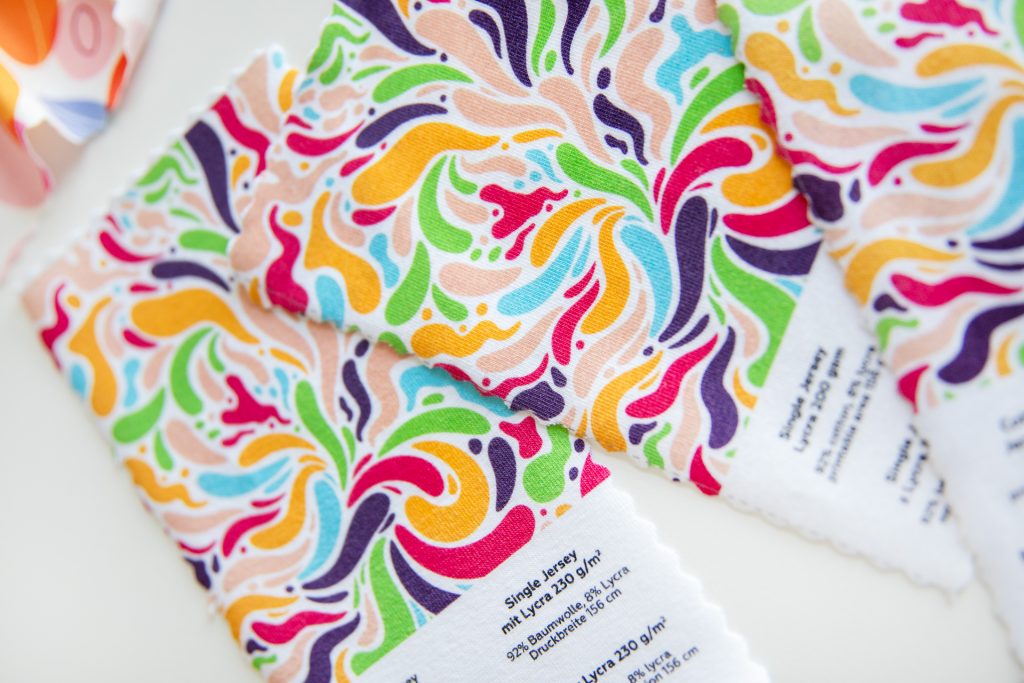
Rib knit
Rib knit can serve two purposes. It can be used for complete garments such as roll-necks, tops, dresses and fitted shirts, or for cuffs, bands and neckline finishes.
Autumn fabrics for fitted styles
Soft and stretchy variants can work well for:
- roll-necks,
- fitted tops,
- shirts,
- dresses.
The ribs can become an additional design feature. Prints that do not require a perfectly smooth base usually work best.
For these applications, consider fabric weight, opacity, elasticity and how the fabric behaves when stretched. Strong ribs become part of the visual effect and can change how small motifs are perceived.
For cuffs and finishing
Other rib-knit variants are used mainly for:
- cuffs,
- waistbands,
- bands,
- neckline finishes.
Here, good recovery and compatibility with the main knit are particularly important. Narrow pattern pieces can also limit how much of the print repeat is visible, so check the design at its final scale.
For both applications, test the print when the fabric is relaxed and when it is stretched.
Cotton twill – for trousers, skirts and overshirts
Cotton twill has a characteristic diagonal weave. It is durable, stable and holds its shape well, while remaining softer than many heavy technical fabrics.
In an autumn collection, you can use it for:
- straight or relaxed trousers,
- skirts,
- shirt jackets and overshirts,
- waistcoats,
- bags, belt bags and backpacks,
- bucket hats.
Twill allows you to take a custom print beyond classic sweatshirts and T-shirts. The same design can appear on a more structured garment or accessory.
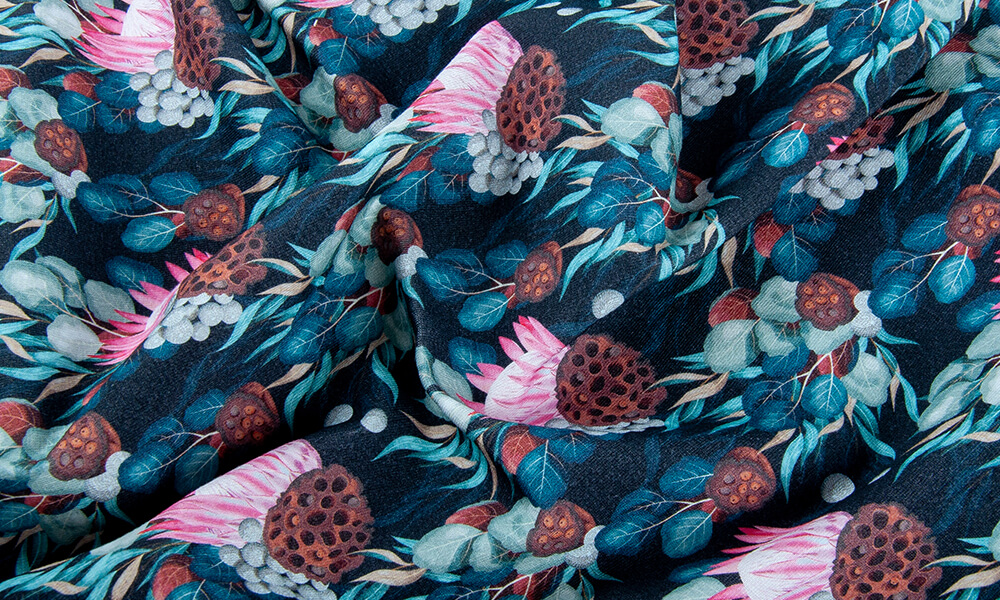
The diagonal weave remains visible after printing. This is not a flaw but a characteristic that should be considered during design development. The texture works particularly well with larger botanical motifs, abstract designs, checks and hand-drawn patterns.
For a more detailed look at its properties and uses, see Cotton Twill Fabric: What is it, What to Sew, and Why Choose It?
Gabardine – for a more elegant transitional collection
Gabardine is a good option when your autumn collection has a more structured, urban or elegant direction. Its dense construction helps garments retain a clean silhouette and highlights tailoring details.
You can use it for:
- trench coats and lightweight coats,
- blazers,
- trousers,
- skirts,
- structured dresses,
- bags and accessories.
Compared with soft sweatshirt knits, gabardine offers less freedom of movement but creates a more defined silhouette. It is not a substitute for a knit. It answers a different need within the collection.
When sewing several layers, pockets, collars or cuffs, check whether the construction becomes too stiff. Your manufacturer’s equipment also matters, as thicker sections may require a more powerful machine and the right needle.
See also: Custom printed cotton gabardine
Softshell – for an outdoor autumn collection
Softshell is worth considering when functionality is a key part of the product. Depending on its technical parameters, it offers protection against wind and changing weather, making it suitable for walking, sports and children’s collections.
Common applications include:
- jackets and gilets,
- outdoor trousers,
- cycling clothing,
- children’s outerwear,
- walking accessories,
- dog clothing.
Softshell is a more technical material than cotton twill or gabardine. Do not choose it simply because it is thick. Its main value comes from weather protection, depending on the specifications of the particular fabric.
It is also important to distinguish softshell from more abrasion-resistant outdoor fabrics. The latter are generally better suited to bags, backpacks and components exposed to greater mechanical wear.
We explain the differences in more detail in Outdoor Fabric vs. Softshell: A Comparison of Outdoor Materials.
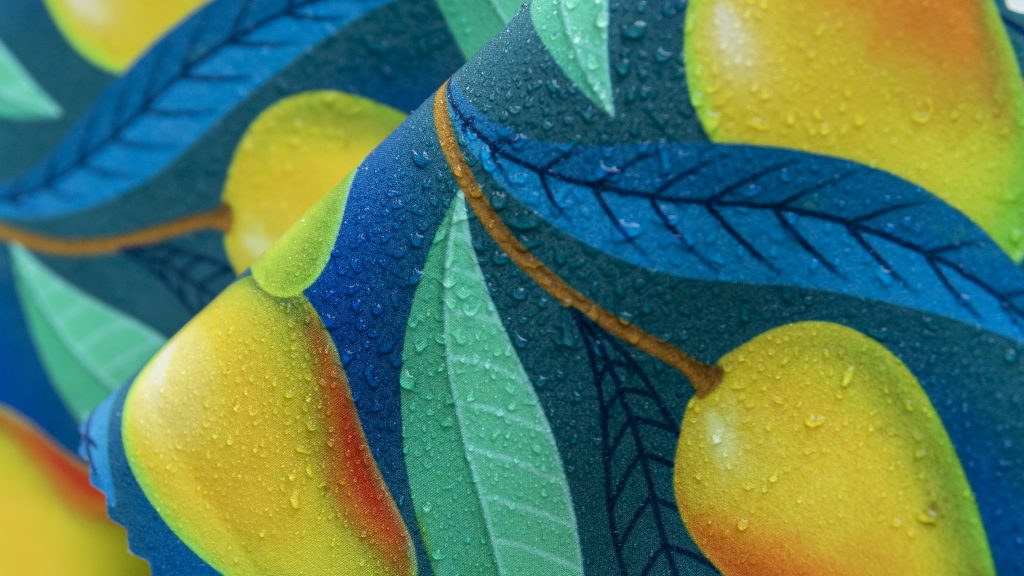
Viscose – when the autumn collection needs to stay light
Autumn does not have to mean only thick, heavy fabrics. Viscose can work well for dresses, shirts and skirts styled with cardigans, blazers or coats. The term “viscose” describes a type of fibre, not one universal fabric. These fabrics can differ significantly in weight, stretch, stability and drape.
Woven viscose
Woven viscose is worth considering for dresses, shirts and skirts. It often works well in fluid silhouettes, but the final effect depends on weave, fabric weight and finish.
Before production, check shrinkage, dimensional stability and how the fabric behaves during cutting and sewing.
Viscose knit
Viscose knits can work in fitted tops and dresses. Their stretch depends on construction and any additional fibres in the blend. The design may change proportions when stretched, so it should also be assessed on a finished prototype.
Viscose will not replace sweatshirt jersey or an outerwear fabric. It can, however, add a lighter product to the collection that works from late summer into the first months of autumn.
How to build a collection around two or three autumn fabrics
Using many different fabrics increases the number of samples, production settings and sewing decisions. For your brand’s first drop, building the collection around six or seven different bases may not be necessary.
A simpler system can consist of three layers.
1. Core fabric
This is the fabric used for products with the highest sales potential.
It could be:
- loopback jersey in a casual collection,
- viscose in a dress collection,
- softshell in an outdoor collection.
2. Supporting fabric
This allows you to create an additional product or an option with a different level of warmth.
Examples include:
- jersey with Lycra for leggings,
- rib knit for roll-necks,
- twill trousers paired with a knitted top,
- viscose dresses worn under cardigans.
3. Statement fabric
This is the fabric used for a product that gives the collection its visual identity.
It could be:
- a printed gabardine jacket,
- a cotton twill overshirt,
- a printed softshell jacket,
- a bag or hat featuring the same print as the clothing.
This approach lets you use one motif across several product categories without creating an overly complex production system.
The most common mistakes when choosing autumn fabrics
Choosing based on fabric weight alone
A higher fabric weight does not automatically mean a fabric will be warmer or better for autumn. Construction, fibre type, density and surface finish also matter.
Printing the same design without separate tests
Moving a design from jersey to twill, or from cotton to polyester, can change its colour, texture and sharpness. Test the print separately on every final fabric.
Not defining the product clearly enough
The question “Which fabric is best for autumn?” is too broad.
A better question is: “Which fabric should I use for a lightweight jacket my customer will wear from September to November?”
Ignoring care requirements
A garment may look excellent before washing but prove too demanding in everyday use. Care instructions should suit the actual customer, product price and intended use.
Using too many fabrics in the first collection
Every additional fabric means separate testing, consumption calculations, sampling and quality control. In a first range, it is often better to master two or three bases than to spread production across too many options.
When comparing suppliers, look at the complete production scenario rather than the price per metre alone. We discuss this in more detail in Why Do Fabric Printing Prices Vary? How to Compare Quotes.
Which fabric is best for your autumn collection?
There is no single fabric that works for every autumn product.
Choose:
- loopback jersey if you are creating comfortable everyday clothing;
- brushed sweatshirt jersey for late-autumn collections and colder days;
- single jersey or rib knit if you need soft base layers;
- cotton twill for casual overshirts, skirts or accessories;
- gabardine if you want a more elegant, structured silhouette;
- the right softshell when the garment needs protection from wind and changeable weather;
- viscose if the collection should also include lighter garments.
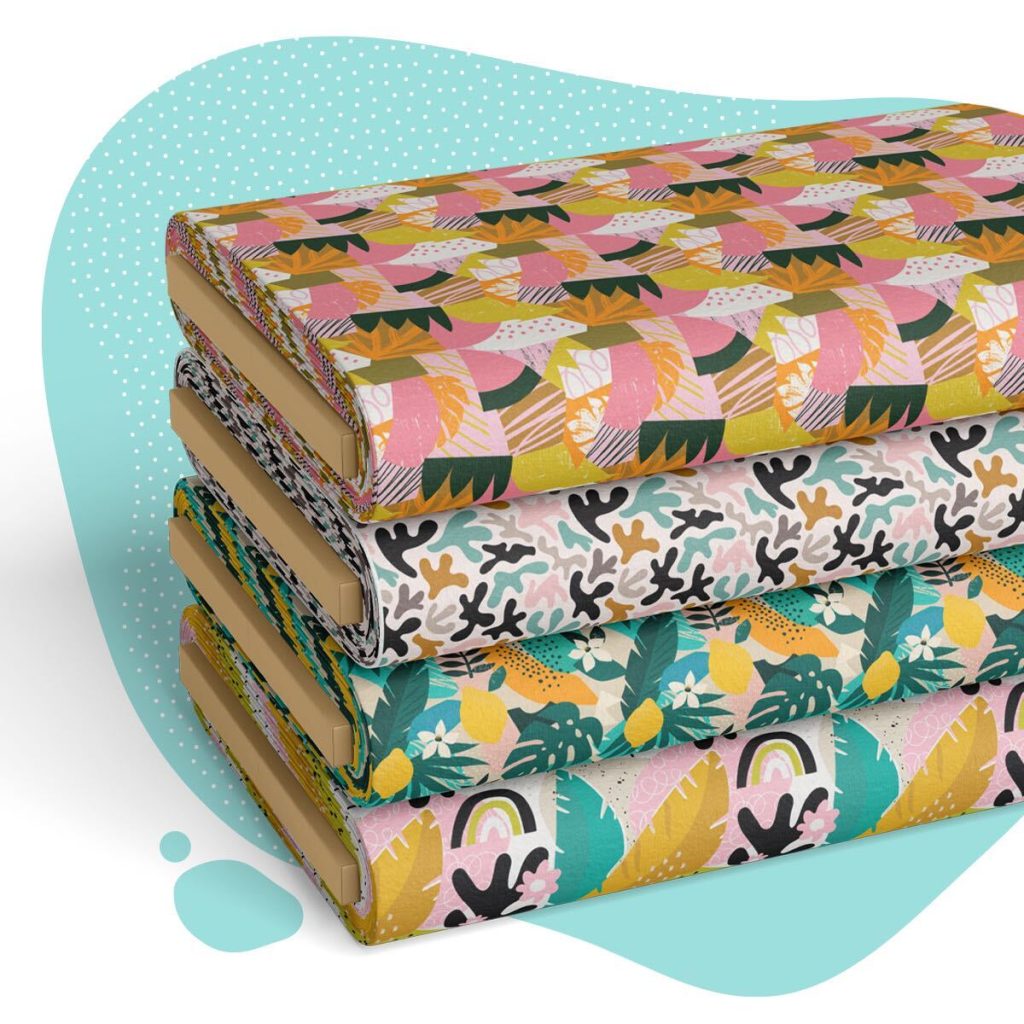
Check your autumn fabrics before building the collection
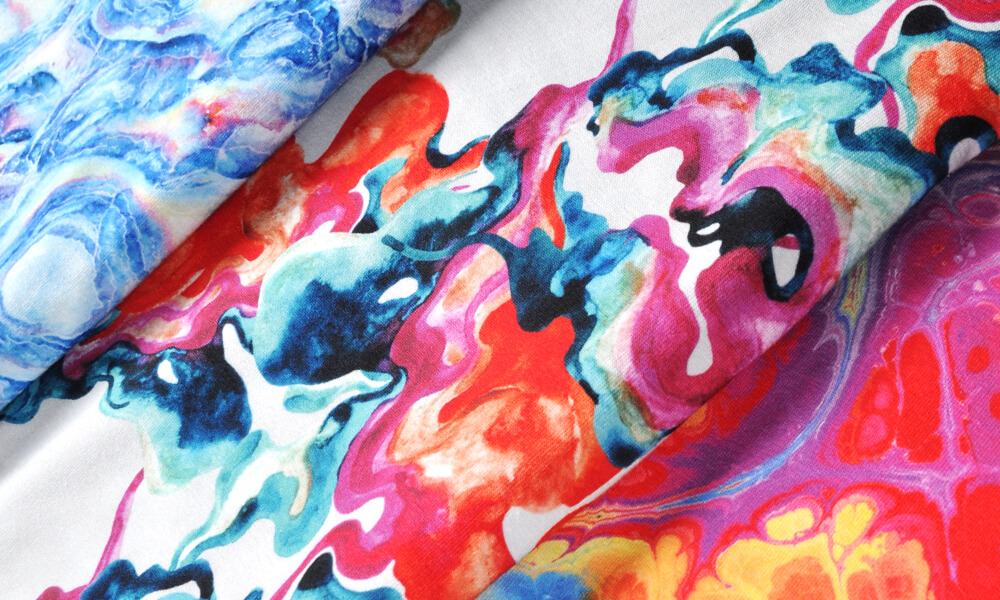
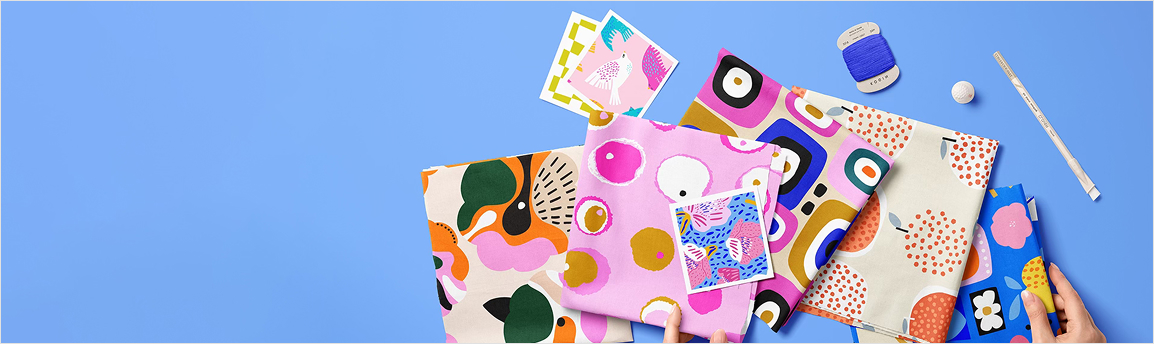
Before finalising your fabrics, compare their weight, structure, elasticity and drape using a woven and knitted fabric sample book. This allows you to see the actual colour, detail clarity, black depth and how the design behaves after stretching and washing.
You can also test your design on two or three different bases before moving into full collection production.
FAQ: Autumn fabrics
There is no single best fabric. Choose loopback or brushed sweatshirt jersey for sweatshirts and sets, single jersey for long-sleeve tops, twill for trousers and overshirts, and gabardine or softshell for transitional outerwear.
Loopback jersey is more versatile and works well at the beginning of the season and for layered outfits. Brushed sweatshirt jersey is warmer, making it better suited to late-autumn and colder-weather collections.
Yes, but you need the right variant. Single jersey works well for lightweight long-sleeve tops, T-shirts and looser layers, while jersey with Lycra is better suited to fitted garments such as leggings.
Cotton twill can work well for a shirt jacket, overshirt or lightweight structured jacket. However, it does not provide the same level of wind or moisture protection as a technical outerwear fabric.
Gabardine is worth considering for a trench coat, blazer or lightweight coat. Its dense construction helps the garment retain its shape and emphasises tailored details.
Loopback jersey and a carefully selected jersey are good starting points. Single jersey works for looser layers, while jersey with Lycra is better for more fitted garments.